PHILOSOPHY OVER PERFORMANCE

The Door That Certainty Can't Open
A layered reflection on know-it-alls, locked doors, certainty, humility, and the quiet rooms wisdom can’t enter without discernment.
FIELD NOTES
LOVE L DAVIS
7/2/202611 min read
The Door That Certainty Can't Open
There’s a particular kind of person who doesn’t walk into a conversation.
They arrive with a verdict.
Before the thought has finished breathing, they’ve already corrected it. Before the question has unfolded, they’ve already answered it. Before the room has warmed into discussion, they’ve found a way to turn the temperature into a debate.
They don’t always mean harm.
Sometimes they’re intelligent. Sometimes they’re well-read. Sometimes they’ve collected enough facts to sound convincing in any room they enter. They know the article. They know the statistic. They know the definition. They know what happened in 1976, what someone should’ve done instead, what the “real” issue is, and why everyone else is missing the point.
And because they know so much, they often fail to notice the one thing standing directly in front of them.
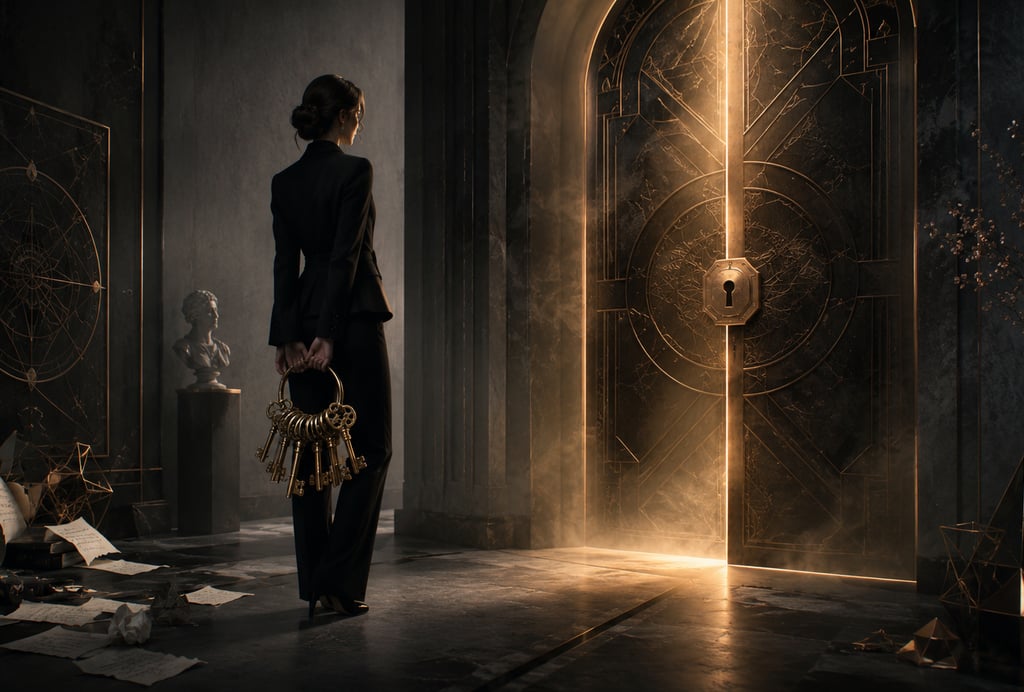
A locked door.
Not a physical door with a brass knob and a warning sign.
Something quieter.
The kind of door that appears when a person’s certainty enters a space before their curiosity does. The kind that closes when someone mistakes quickness for depth. The kind that doesn’t announce itself, because most locked doors in human interaction don’t slam shut.
They simply stop opening.
At first, a know-it-all can appear powerful. They seem prepared. They seem sharp. They seem unshaken. They speak with the confidence of someone who’s already reached the conclusion everyone else is still trying to understand.
But there’s a difference between knowing the answer and understanding the room.
That difference is where the door begins.
A know-it-all often believes knowledge is access. They assume that because they have information, they also have entry. They confuse facts with permission. They confuse correction with contribution. They confuse being right with being received.
But every room has more than one layer.
There’s the room of facts.
Then there’s the room of timing.
There’s the room of logic.
Then there’s the room of emotional temperature.
There’s the room of what was said.
Then there’s the room of what someone was finally brave enough to say out loud.
And some people never get past the first room because they’re too busy proving they belong in all of them.
That’s the strange thing about certainty. It can look like confidence while functioning like a lock.
A person may have the key to the information, but not the key to the conversation. They may understand the topic, but not the tone. They may be able to explain the concept, but not perceive the hesitation in someone’s voice. They may be able to correct the sentence, but completely miss the courage it took for the sentence to be spoken.
So the door stays closed.
Not because they weren’t smart enough.
Because they weren’t quiet enough to hear it unlock.
There’s something almost tragic about the know-it-all archetype because, underneath the constant need to correct, there may be a deeper hunger to be trusted. To be seen as competent. To be admired. To avoid the vulnerability of not knowing. To feel safe by staying ahead of the conversation.
Certainty can become armor.
And like most armor, it protects and restricts at the same time.
The person wearing it may feel safe, but they can’t move freely. They can’t bend into nuance. They can’t sit with ambiguity. They can’t let a thought remain unfinished without rushing to nail it to the floor. They can’t allow silence to be fertile because silence feels too much like exposure.
So they fill the space.
They over-answer.
They over-explain.
They over-correct.
They become the person with a keychain full of answers, standing in front of a door that doesn’t open to performance.
Because wisdom doesn’t respond well to force.
Neither does trust.
Neither does intimacy.
Neither does genuine conversation.
There are some rooms that only open when the person outside stops trying to prove they deserve entry.
That’s where the know-it-all loses their advantage.
They may win the argument and lose access. They may win the correction and lose closeness. They may win the fact-check and lose the invitation to be included in someone’s inner world.
And the most interesting part is that they may never notice the loss.
Because locked doors don’t always look like rejection.
Sometimes they look like shorter answers.
“Yeah, I get it.”
Sometimes they look like changed subjects.
“Anyway…”
Sometimes they look like people no longer sharing half-formed thoughts.
Sometimes they look like someone keeping their dreams, fears, questions, and deeper reflections away from the person who always turns openness into a courtroom.
The know-it-all may still be present.
Still included.
Still spoken to.
Still technically “in the room.”
But something has changed.
They’ve been moved from the living room of trust to the hallway of polite exchange.
And because they’re still hearing words, they may not realize they’re no longer receiving access.
That’s how subtle the locked door can be.
People don’t always announce when they’ve decided you’re unsafe for unfinished thoughts. They don’t always say, “I no longer trust you with the part of me that’s still becoming.” They may simply stop offering you the material that can’t survive unnecessary scrutiny.
That’s not always punishment.
Sometimes it’s protection.
Because not every thought is ready for examination. Some thoughts need air before analysis. Some questions need space before structure. Some ideas need to wander before they become wise. Some people speak not because they need an answer, but because they’re trying to hear themselves think.
The know-it-all often misses this.
To them, an unfinished thought looks like a problem.
To a deeper listener, it looks like a doorway.
And that’s the difference.
One person hears incompletion and rushes to close it.
Another hears incompletion and recognizes that something is still entering the room.
This is why the locked door metaphor matters.
A locked door doesn’t only represent exclusion. It can also represent discernment. It can represent a boundary around the sacred process of becoming. It can represent the part of a person that refuses to be interrupted before it has had a chance to understand itself.
Not every door is locked because someone is cruel.
Some doors are locked because the last person who entered mishandled the room.
That’s true in conversations.
That’s true in relationships.
That’s true in creative work.
That’s true in leadership.
That’s true in family dynamics, professional spaces, spiritual exploration, and every arena where people confuse certainty with authority.
There are people who know how to speak powerfully but don’t know how to enter gently.
There are people who know how to make a point but don’t know how to hold a moment.
There are people who know how to debate but don’t know how to witness.
And witnessing requires a different kind of intelligence.
It doesn’t rush to dominate the meaning.
It doesn’t treat every pause as weakness.
It doesn’t confuse someone’s uncertainty with incompetence.
It understands that some rooms require the removal of shoes.
Not because the person inside is fragile.
Because the floor is sacred.
That kind of intelligence is often underestimated because it doesn’t always sound impressive. It’s not flashy. It doesn’t race to be the first to respond. It doesn’t need to announce its credentials before it listens. It doesn’t perform comprehension by interrupting with a superior example.
It has enough confidence to let the moment reveal itself.
That’s a rare discipline.
Especially in a culture that rewards speed, loudness, cleverness, instant reaction, and the illusion of expertise.
We live in an age where people can know a little about everything and still understand very little about themselves. Information is everywhere. Interpretive maturity is not. Correction is easy. Discernment is harder. Reaction is quick. Reverence takes discipline.
The know-it-all is often a symptom of that imbalance.
A person can consume enough information to become fluent in commentary without ever becoming grounded in wisdom. They can memorize language without metabolizing meaning. They can speak the vocabulary of healing, strategy, faith, psychology, politics, business, creativity, or emotional intelligence while still using their knowledge as a weapon instead of a bridge.
And this is where the real danger hides.
The danger is not simply that know-it-alls are annoying.
That’s too shallow.
The deeper danger is that they can make people distrust their own process.
When every idea is corrected too early, the thinker begins to censor themselves. When every question is treated like ignorance, curiosity becomes guarded. When every vulnerable observation becomes a debate, honesty starts looking for safer rooms.
A know-it-all doesn’t always silence people by yelling.
Sometimes they silence people by making every shared thought too expensive.
Now the person has to calculate before speaking.
Will this be picked apart?
Will this be turned into a lecture?
Will I have to defend something I was only beginning to explore?
Will I regret letting this thought leave my mouth?
That’s how a conversation becomes a locked building with too many security checkpoints.
And eventually, people stop trying to enter.
This is why not every intelligent person is easy to talk to.
Some people’s intelligence has no hospitality.
It has structure, but no warmth.
It has accuracy, but no room.
It has sharpness, but no softness.
It has memory, but no mercy.
And when intelligence has no hospitality, it doesn’t feel like illumination. It feels like inspection.
Nobody wants to be searched every time they speak.
This doesn’t mean truth should be abandoned. It doesn’t mean facts don’t matter. It doesn’t mean every feeling should be treated as a fact or every opinion should float untouched through the room.
That’s not the point.
The point is that truth handled without timing can become a weapon. Correction without relationship can become intrusion. Knowledge without humility can become noise. And certainty without curiosity can become a locked door with a person standing proudly on the wrong side of it.
The irony is that the know-it-all often believes they’re opening the conversation.
They think they’re adding clarity.
They think they’re helping.
They think they’re strengthening the point.
They think they’re preventing error.
And sometimes, perhaps, they are.
But help that doesn’t consider the receiver often becomes control wearing a helpful face.
There’s a difference between offering a key and forcing a door.
A key is respectful.
A key says, “This may help, and you’re free to use it.”
Force says, “I’ve decided this room should open now.”
That distinction changes everything.
Because people are not doors to be kicked in with information.
They’re interiors.
They have rooms that require trust.
They have hallways where memory lives.
They have windows they open only for certain kinds of air.
They have basements full of things they’re still sorting through.
They have attics where old versions of themselves are stored in boxes labeled “I’m not ready yet.”
And when someone storms through with certainty, flipping on lights, opening drawers, correcting the furniture, and announcing what everything means, they shouldn’t be surprised when they’re no longer invited past the porch.
The porch is still contact.
But it’s not intimacy.
It’s not depth.
It’s not access.
It’s the place where people speak safely because nothing valuable is left exposed.
This is one of the quiet costs of being a know-it-all.
You may never know what people stopped telling you.
You may never know what rooms closed after you left.
You may never know what insight, confession, idea, dream, concern, or revelation almost reached you — but turned around when it sensed there would be no softness waiting on the other side.
And that’s worth sitting with.
Because sometimes the deepest losses are not dramatic exits.
Sometimes the deepest losses are conversations that become shallower over time.
A little less honesty.
A little less wonder.
A little less laughter.
A little less “I’ve never told anyone this, but…”
A little less “Can I think out loud with you?”
A little less “This might not make sense yet, but…”
Those are not small losses.
Those are doors.
And once enough of them close, a person may still be surrounded by people and have no true access to anyone.
That’s the paradox of the know-it-all.
They may be heard often, but trusted rarely.
They may be consulted for facts, but avoided for vulnerability.
They may be respected for what they know, but not invited into what others are still becoming.
And at some point, that raises a deeper question.
What good is being right in every room if no one feels safe enough to open the deeper ones?
This question matters beyond personal relationships. It matters in professional spaces too.
In workplaces, know-it-alls can suffocate innovation before it matures. They can make brainstorming feel like a performance review. They can turn collaborative thinking into intellectual self-defense. They can make quieter contributors withdraw, not because they lack ideas, but because they’re tired of watching every raw thought get measured before it has had time to grow.
That’s dangerous.
Because early ideas are rarely polished.
New strategies often arrive messy.
Creative solutions can look foolish before they become brilliant.
And if the room punishes incompletion, the room will eventually stop producing anything original.
It’ll only produce what feels safe enough to say.
That’s how certainty can become an organizational ceiling.
A team may think it has a creativity problem when it actually has a listening problem. A family may think someone is distant when they’ve actually learned that distance is safer than disclosure. A friendship may think it’s “not as close anymore” when one person has simply grown tired of having their interior life treated like an open debate.
Locked doors are rarely random.
They’re usually records.
They remember how people entered.
They remember who listened.
They remember who made the room smaller.
They remember who needed to be the smartest voice so badly that everyone else stopped offering their honest one.
And this is where the reflection becomes uncomfortable, because the know-it-all is not always someone else.
Sometimes it’s a mood.
A defense.
A survival strategy.
A way we perform strength when we’re afraid of uncertainty.
A way we over-function when silence feels too vulnerable.
A way we rush to answer because not knowing makes us feel small.
There are moments when anyone can become the person outside the door with too many keys and too little reverence.
The question is whether we can notice it before the room closes.
Because wisdom is not simply the accumulation of what we know.
Wisdom is knowing how to carry knowledge without making other people feel crushed beneath it.
It’s knowing when to speak and when to wait.
It’s knowing when correction is necessary and when it’s just a disguised appetite for control.
It’s knowing when someone needs clarity and when they need companionship inside the question.
It’s knowing that not every silence is empty.
Some silences are unlocking something.
That’s the door certainty cannot open.
Not because certainty is useless.
There are moments when certainty is necessary. There are times when truth must stand firm, when facts matter, when delusion needs interruption, when clarity protects people from confusion. Certainty has its place.
But certainty must know its jurisdiction.
It can't govern every room.
It can't enter every chamber.
It can't interpret every pause.
It can't heal every uncertainty by overpowering it.
Some doors open only for humility.
Some open only for patience.
Some open only for a person who can stand outside without making the locked door a personal insult.
And some doors stay closed until the person on the other side believes their unfinished self won't be punished for emerging.
That’s a sacred kind of access.
Not everyone deserves it.
Not because they’re unworthy as people.
Because they haven’t learned how to enter without rearranging the room.
The know-it-all may continue collecting answers. They may continue sharpening arguments. They may continue mistaking applause for intimacy, agreement for trust, and silence for defeat.
But somewhere, behind a door they can't open, deeper wisdom may be taking place without them.
A softer conversation.
A braver confession.
A more honest question.
A thought still stretching toward its final shape.
A room they could’ve entered, had they not arrived already convinced they knew what was inside.
And maybe that’s the part worth carrying forward:
The mind can collect keys for years and still remain outside the rooms that require humility.
So perhaps the real question isn't how much someone knows.
Perhaps the real question is how many doors their certainty has quietly closed before wisdom ever had the chance to enter.
sigmaelysian@inspirecreatives.org
© 2026 Sigma Elysian. All Rights Reserved.


“Some worlds are built for visibility. Others are built for depth.”
SIGMA ELYSIAN
An authored intellectual environment of distinct worlds, strategic inquiry, original frameworks, and creative work.
EXPLORE
For thoughtful inquiries and intentional correspondence.