PHILOSOPHY OVER PERFORMANCE

What Is a No-Clean-Move Position?
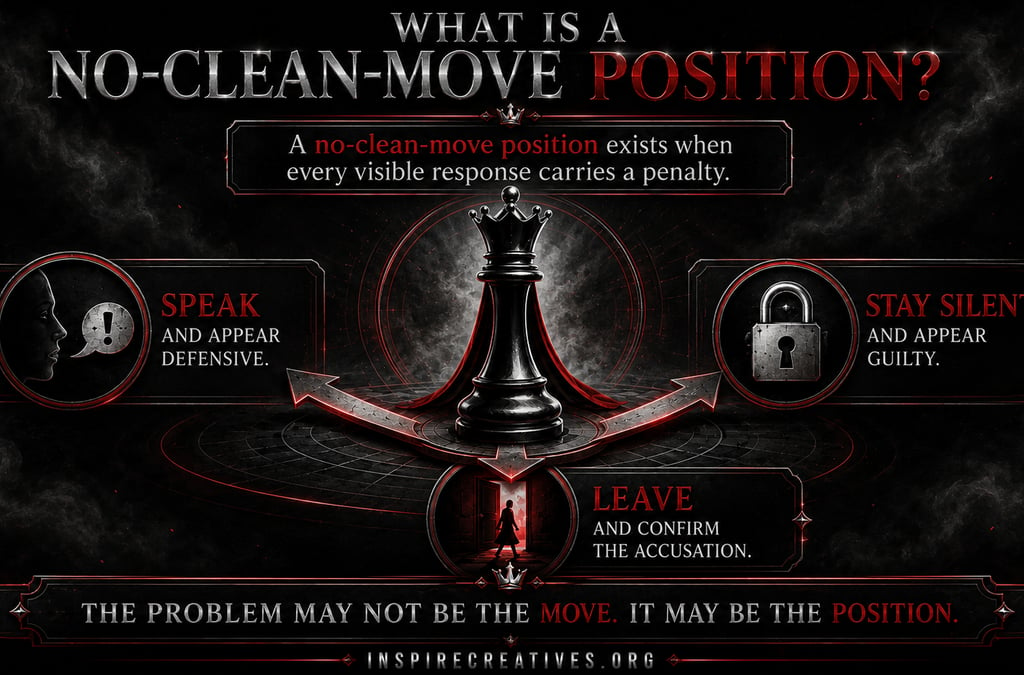
A no-clean-move position exists when every visible response carries a penalty. Rather than treating every difficult choice as manipulation, we examine the difference between a hard decision and a compromised position and why the real issue may not be the move, but the structure surrounding it.
Love L. Davis
7/15/20265 min read
What Is a No-Clean-Move Position?
Let’s face it. Not every rough patch or difficult situation is trap.
In some instances, we encounter decisions that could be painful while other choices may require trade-offs. We may have moments when courage, sacrifice, patience, and maturity are a requirement.
Life doesn’t always offer clean outcomes and just because a decision may provoke feelings of discomfort doesn’t necessarily mean someone is being manipulated.
But there’s a specific kind of position that deserves closer language.
A no-clean-move position exists when every visible response carries a penalty.
If you speak up, you look defensive.
If you remain silent, and you look guilty.
If you leave, then you’re confirming the accusations.
If you explain your position, you look like you’re negotiating your credibility.
If you refuse to explain yourself, you’re framed as evasive.
In all of these situations, the problem isn’t necessarily the move.
It may be the position itself.
The Difference Between a Hard Choice and a No-Clean-Move Position
A hard choice includes real options with real costs. This looks like choosing between two deadlines, two opportunities, two responsibilities, two relationships, or two imperfect outcomes. Although deciding may be uncomfortable, the choices are legitimate.
A no-clean-move position is different.
The available responses have already been loaded with meaning. The person responding isn’t simply choosing between options. They’re choosing inside a frame where each option has been assigned a damaging interpretation.
This is what makes being in such a position so difficult.
The move isn’t being evaluated from a neutral perspective. It has already been placed inside a narrative.
For example, imagine someone being accused of acting “too sensitive” after raising valid concerns. If they proceed by explaining their position, their explanation would be interpreted as proof that they’re too emotional. If they chose not to defend their position at all, their silence may be interpreted as truth behind the accusation. If they decided to completely remove themselves, their distance may be framed as immaturity.
The issue is no longer only the concern they raised.
The new issue becomes how their response can be interpreted.
That is the architecture of a no-clean-move position.
Why These Positions Are So Draining
No-clean-move positions create mental exhaustion because they pressure a person to search for the perfect response inside a structure designed to punish the response itself.
The person may begin thinking:
What can I say that won’t be twisted?
How can I leave without confirming the story?
How can I stay without surrendering my dignity?
How can I explain without appearing desperate?
How can I protect myself without looking guilty?
This is why these situations often create overthinking. The mind keeps searching for a clean move because it assumes the right wording, tone, timing, or explanation will solve the problem.
But when the position itself is compromised, a cleaner sentence may not create a cleaner outcome.
Sometimes the pressure isn't asking for clarity. It’s asking for your participation.
The Role of Framing
A no-clean-move position often depends on framing.
Framing determines what a response is changed into before the response is given.
If the frame says, “You’re difficult,” then directness becomes aggression.
If the frame says, “You’re guilty,” then silence becomes admission.
If the frame says, “You’re selfish,” then boundaries become cruelty.
If the frame says, “You’re unstable,” then emotion becomes evidence.
If the frame says, “You always think you’re right,” then clarity becomes arrogance.
This is why the same response can be interpreted differently depending on the position assigned to the person giving it.
A calm explanation from one person may be called mature.
A calm explanation from another may be called defensive.
A boundary from one person may be called healthy.
A boundary from another may be called disrespectful.
The move didn’t change.
The position did.
Where No-Clean-Move Positions Show Up
These positions can appear in family dynamics, friendships, workplaces, leadership environments, online spaces, and social groups.
In a family setting, someone may be expected to participate in a familiar role. If they stop explaining, they’re “acting different.” If they explain, they’re “making things complicated.” If they leave, they’re “abandoning the family.”
In a workplace, an employee may be invited to give honest feedback. If they speak freely, they’re “not a team player.” If they soften the truth, the issue remains unresolved. If they stay quiet, leadership assumes there’s no concerns.
In friendships, a person may ask for reciprocity. If they bring it up, they’re “keeping score.” If they say nothing, the imbalance continues. If they withdraw, they’re “acting distant.”
In each case, the difficulty isn’t that the decisions are uncomfortable. It’s that the person’s responses have already been placed under penalty.
Why the Distinction Matters
It’s important not to call every hard decision a no-clean-move position.
Some situations are simply complex. They aren’t manipulating us; they’re reacting from their own limitations. Some consequences are natural results of choice, not evidence of a trap. Mature analysis requires discipline.
The distinction matters because overgeneralizing weakens discernment.
A difficult choice asks:
Which cost am I willing to accept?
A false choice asks:
What option has been hidden from view?
A no-clean-move position asks:
Why has every visible response already been assigned a penalty?
That last question changes the analysis.
Instead of obsessing over the perfect move, the person begins examining the structure around the move.
Who created the frame?
Who benefits if I stay inside it?
What is my response being positioned to prove?
What happens if I stop trying to win approval from a compromised frame?
What would protect my position, even if it doesn’t protect my image in the moment?
These questions create clarity.
What to Do Inside a No-Clean-Move Position
The first step is to stop assuming that the cleanest move is always available.
Sometimes the goal isn’t to find a response that carries no cost. The goal is to choose the response that preserves the most integrity, clarity, and long-term position.
That means speaking once, clearly, without entering endless defense.
Refusing to perform innocence for people invested in misunderstanding.
Documenting instead of debating.
Leaving without trying to control the story afterward.
Accepting that someone may misread your move because the frame was never neutral to begin with.
This doesn’t suggest passivity. It means becoming less dependent on a rigged interpretation.
A no-clean-move position doesn’t always require a dramatic exit. Sometimes it requires a quieter shift: fewer explanations, stronger boundaries, slower responses, better timing, and a refusal to keep proving what the position was designed to question.
The Real Lesson
A no-clean-move position teaches us that strategy isn’t just about choosing the right action. It’s also about recognizing the field in which the action will be interpreted.
Some situations can’t be solved by better wording because the words aren’t the real issue.
Some conflicts can’t be repaired by more explanation because the explanation has become part of the penalty.
Some rooms don’t need another performance of clarity. They need to be read more accurately.
The question isn’t always:
What should I do?
Sometimes the deeper question is:
What position am I being asked to occupy if I respond this way?
That is where discernment begins.
Because in a no-clean-move position, the move may look like the problem.
But the position is often what needs to be examined first.
sigmaelysian@inspirecreatives.org
© 2026 Sigma Elysian. All Rights Reserved.


“Some worlds are built for visibility. Others are built for depth.”
SIGMA ELYSIAN
An authored intellectual environment of distinct worlds, strategic inquiry, original frameworks, and creative work.
EXPLORE
For thoughtful inquiries and intentional correspondence.