PHILOSOPHY OVER PERFORMANCE

Confidence vs. Performance: What We Get Wrong About Children
Confidence in children is often mistaken for performance. Learn the difference and why true confidence begins from within.
Love Davis
6/30/20262 min read
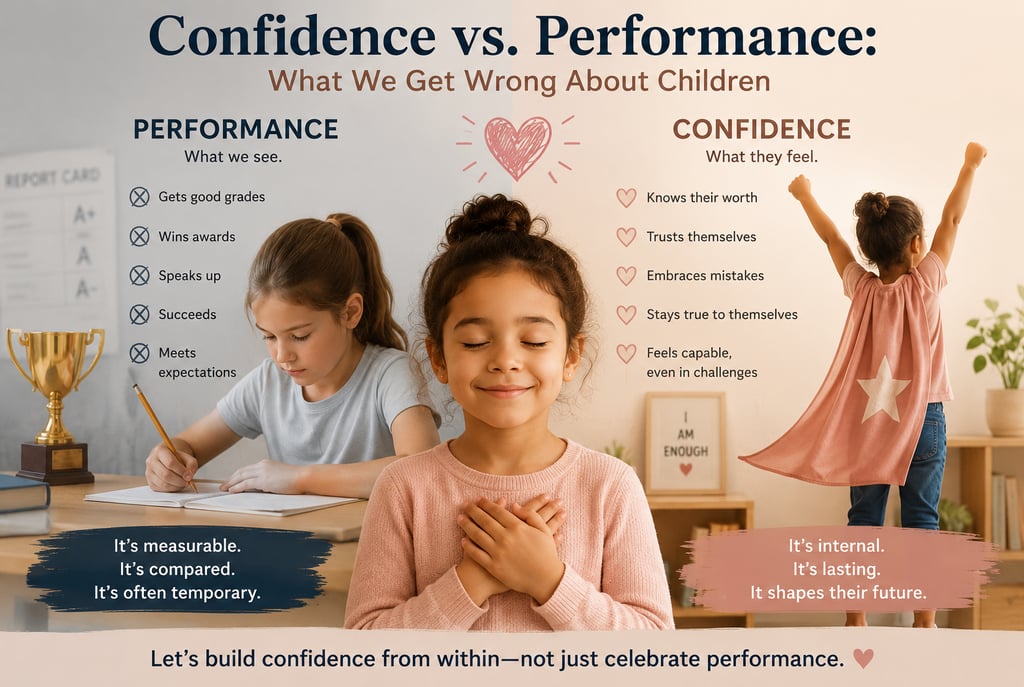
Confidence vs. Performance: What We Get Wrong About Children
Confidence in children is often misunderstood.
It's frequently measured by what a child is willing to do, how well they perform, or how confidently they present themselves in visible situations. A child who speaks up is seen as confident. A child who hesitates is often seen as unsure.
But performance isn't the same as confidence.
And confusing the two can quietly shape how a child begins to see themselves.
The Illusion of Confidence
Performance is external.
It's what can be seen, measured, and evaluated.
Confidence is internal.
It's what a child feels about themselves—often long before it's ever expressed outwardly.
A child may perform well in certain environments and still feel uncertain within themselves. Another child may appear reserved and still carry a strong internal sense of self.
What is visible isn't always what's true.
This is where early awareness begins to matter.
Unique Me was designed to introduce this understanding before patterns begin to form unnoticed.
How Performance Becomes the Standard
In many environments, performance becomes the reference point.
Children are praised when they:
answer quickly
participate visibly
succeed outwardly
Over time, this creates an unspoken message:
“Confidence looks like performance.”
And when that message is repeated, children begin to internalize it.
They may start to believe:
their value is tied to how they perform
their confidence depends on how others respond
their worth is connected to outcomes
These beliefs aren't explicitly taught.
They're formed through consistent reinforcement.
What Happens Beneath the Surface
When performance is prioritized over internal understanding, children begin to disconnect from themselves.
They may:
seek validation instead of self-trust
hesitate when they're unsure
avoid situations where they might not succeed
measure themselves against others
Even when they perform well, the confidence remains conditional.
It depends on:
external response rather than internal stability
The Difference That Matters
Confidence is not:
how loudly a child speaks
how quickly they respond
how often they succeed
Confidence is:
how a child experiences themselves regardless of the outcome
It's built through:
self-recognition
emotional understanding
consistent internal reinforcement
Not just external praise.
A More Grounded Approach
Instead of focusing only on what children do…
There's an opportunity to focus on:
how they experience what they do
This means:
acknowledging effort without attaching identity to results
allowing space for uncertainty without labeling it as weakness
reinforcing who they are, not just what they achieve
These shifts are subtle.
But they change everything.
Why This Matters Early
When children begin to associate confidence with performance, they learn to rely on outcomes to define themselves.
When they begin to understand confidence as internal, they develop:
resilience
self-trust
emotional stability
These qualities don't depend on constant success.
They remain—even when outcomes change.
What We Often Miss
A child who performs well isn't always confident.
A child who hesitates isn't always lacking confidence.
And a child who is still learning how to express themselves is not behind.
They're developing.
Closing Thought
Confidence is not something that appears when children succeed.
It's something that develops as they begin to understand who they are—separate from how they perform.
This is part of the reason why Unique Me focuses on helping children build confidence from within—so it's not dependent on performance but grounded in self-understanding.
If you’d like to explore this approach further, you can begin here.
If this resonates, you can begin exploring this approach through Unique Me.
sigmaelysian@inspirecreatives.org
© 2026 Sigma Elysian. All Rights Reserved.


“Some worlds are built for visibility. Others are built for depth.”
SIGMA ELYSIAN
An authored intellectual environment of distinct worlds, strategic inquiry, original frameworks, and creative work.
EXPLORE
For thoughtful inquiries and intentional correspondence.